Monday, 5 August 2013

Art In Action - Waterperry House

On Friday 19th July members of Solihull Embroiderers' Guild had a day out to Art in Action at Waterperry House. The weather was extremely kind to us - the sun shone all day. There was lots to see with just about every form of art and craft and performance art on display including music in the open air theatre, dance, painting, sculpture, ceramics, glass blowing, calligraphy, printing, metalwork and jewellery, textiles, woodwork ...... not to mention the beautiful gardens of Waterperry House, ( I didn't have time to visit those this year but will have to make time next year.
The painting marquee - lots of different styles to suit all tastes.

Weaving in the textiles marquee with Fiona Rutherford

Fabulous printed fabrics - note the many sunhats being used on this hot day!

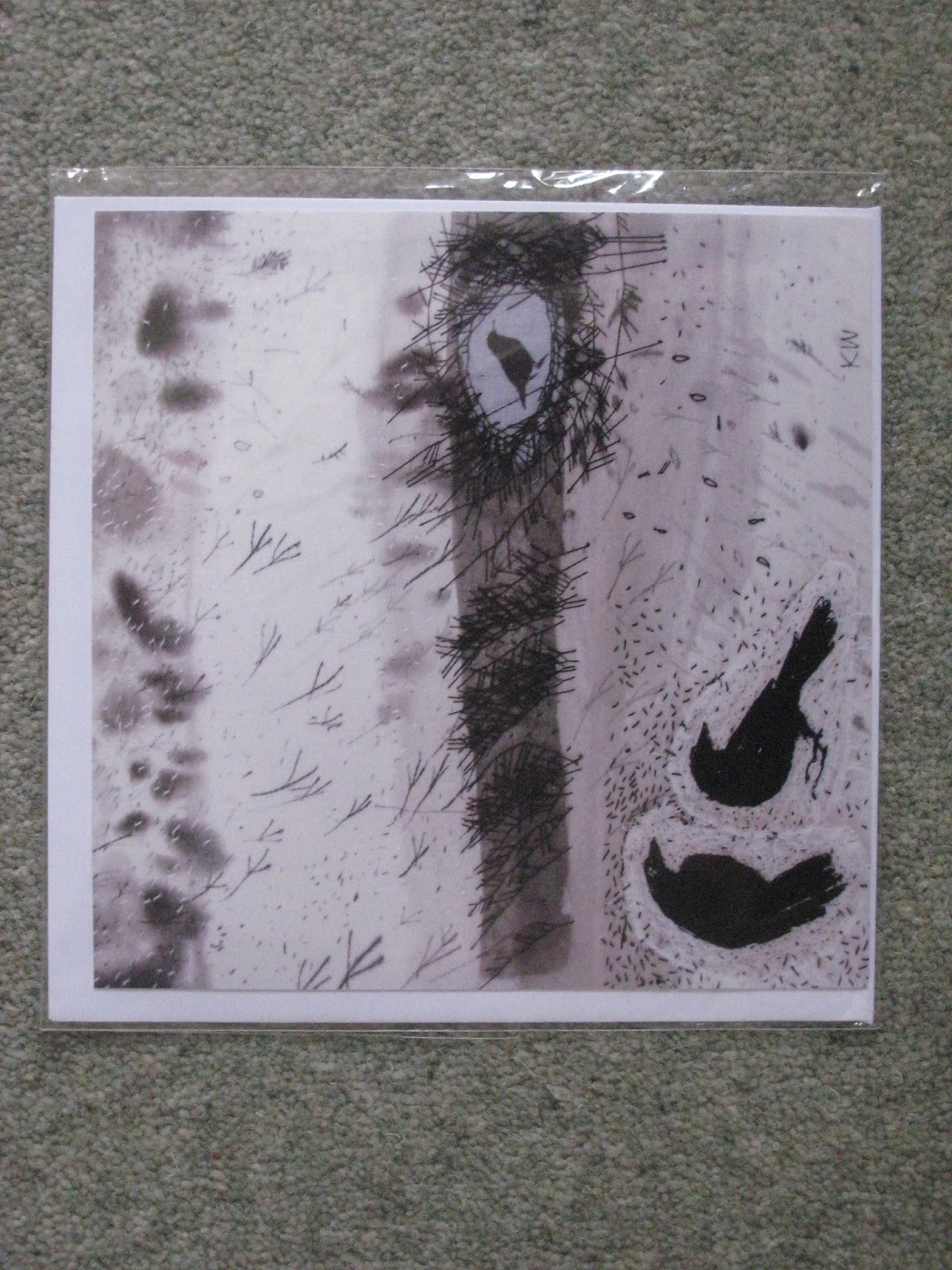
Kate Wells artworks on paper with embroidery. Her use of black and white was very effective.
 

There were lots of demonstrations to catch your attention. These two were in the metal work marquee


In the Wood Working Marquee
Some of the wood carvings were amazing

Making musical instruments

 Print making - This was a print by Vladimir Vorobiev showing very fine detailing

 
My favourite printmaker was Laura Boswell who was demonstrating Japanese woodblock printing. I was so busy watching that I didn't take any photos, but I did buy some of her cards
 
 
I also bought these cards from Wendy Dolan, another of my favourite textile artists


and this black and white card from Kate Wells.

 
This was a lovely landscape by Carol Griffin - vitreous enamel on copper.
 
Memories by Julie Heston incorporated silk painting and heavy machine embroidery to produce this colourful 3D piece
 
Harriet Riddell was a 'performance machine embroiderer' in the Newcomers Marquee. Her work was very lively and slightly quirky. She would stich your portrait in about 15 minutes. Certainly a name to watch out for. if you want to see more of her work go to INSTITCHYOU.CO.UK


I loved these metal work brooches by Becky Crow. Each one told its own story .
 
It was a great day out. congratulations to Waterperry for putting on such a fantastic display and looking after everyone so well on such a hot day (the jugs of free water available everywhere were much appreciated)


Friday, 26 July 2013

DYEING THE THREADS

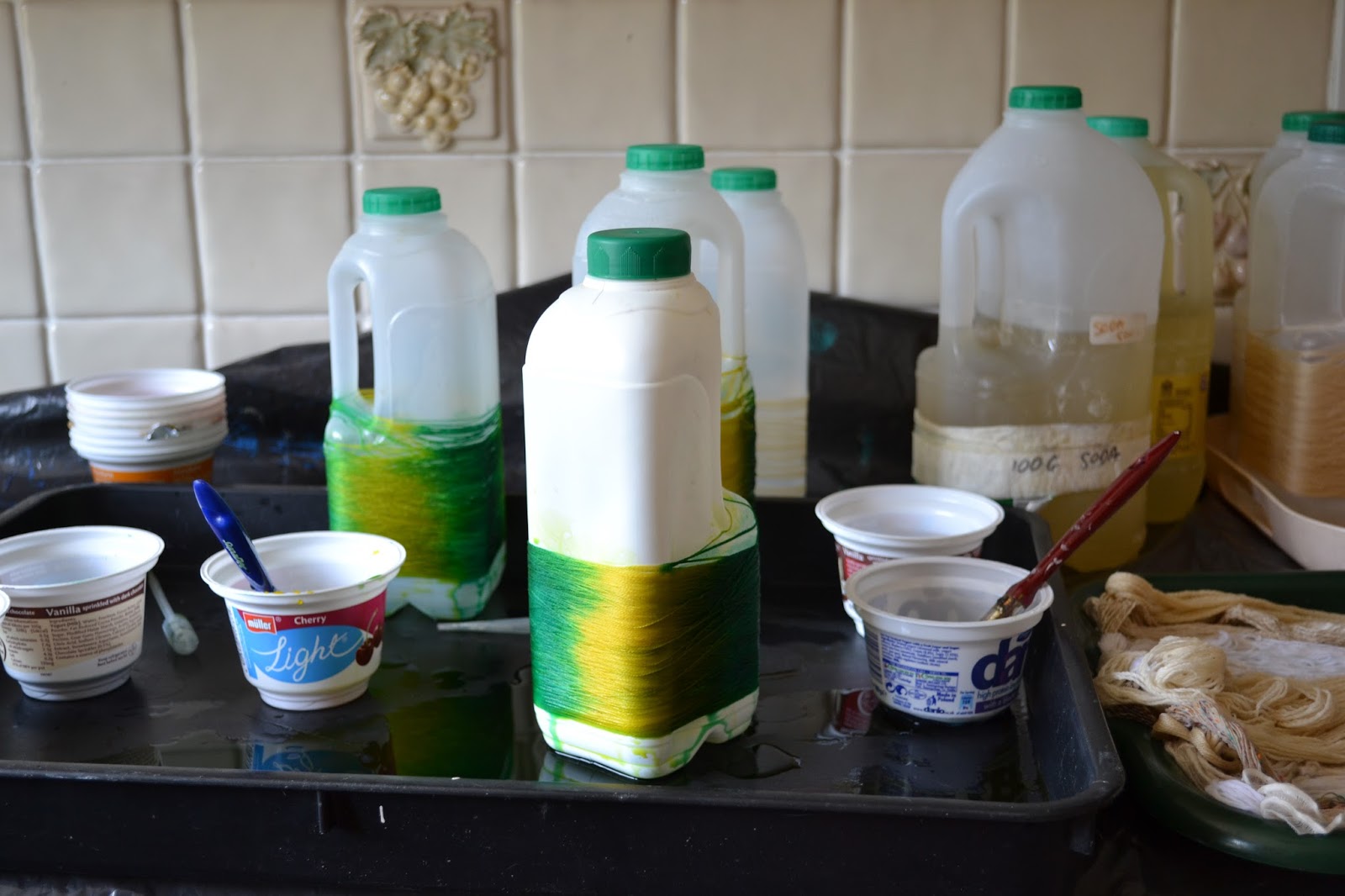
 The threads were first soaked in a soda/salt solution for about an hour. Skeins can be laid out in a litter tray. The plastic bottles need to be filled with water to weight them down in the plastic bowl. Pack as many bottles into the bowl as possible as this will reduce the amount of soda solution you need to fill the container. Make sure that the threads are fully immersed.
 
I mix my dyes up in jam jars and then pour out small amounts into plastic pots. The dye in these pots will become contaminated with soda salt solution as I dip my paint brush in and out so that any dye left over will not be able to be reused. The dye in the jam jars however can be stored somewhere cool, such as a garage, and will keep for use at a later date.

 
1/4 inch and 1/2 inch brushes are ideal for painting the dye onto the threads. The colours can be painted on in stripes or completely randomly. Garden gravel trays are great for standing your dyes and threads in. (helps contain any spillages)  

 
Skeins can be laid flat in the bottom of these trays and several threads painted together.
 
I use thin plastic bags to cover each painted thread bottle and cut long pieces of plastic from rubbish sacks to wrap the skeins, several at a time.

 
These are then rolled up and put into a container
 
All the threads are left over night before I rinse them well using first cold water and then warm water with a few drops of synthrapol rinsing detergent (if you don't have any, use washing up detergent instead). Finally they are rinsed until no more dye is being lost. The threads on the bottles remain on the bottles for the whole process which will stop some of those terrible tangles.
 
 
Finally the threads can be hung up to dry. These garden tags are really useful for attaching the bottles and hangers to the washing line. Not sure what the neighbours think about our strange washing! 

 
For this batch of threads, which were mostly different weights of silks, I used emerald green, lime green, forest green, bright yellow and a medium blue.

 
These were the thicker threads which I will store on the hanger for now.

 
These are a very fine mulberry silk which I can use for hand stitching or machine stitching so I like to wind some onto cotton reels to use straight on the sewing machine.

 
These are slightly thicker mulberry silk - great for hand stitching but can also be used in the spool on the sewing machine.
 
 
These are some threads I dyed a couple of weeks ago, using up various odds and ends of dye which I had stored for some time, so a complete mixture of colours.


Tuesday, 16 July 2013

Preparing Threads for Dyeing

Had a good day dyeing threads at the inspire group the other week and decided it was time to dye some more. I have used a lot in stitching lately and I am low on some colours.
The preparation is time consuming but it is worth it to prevent the threads tangling during the dyeing process.
 
If the threads are reasonably thick, I wind them into skeins, tie the loose ends together and then tie a different thread around the skein in at least 3 places (not too tight though as this may prevent the die penetrating and leave a white mark).

If the skein has more than about 20 wraps, tie them with a figure of 8 to help keep the threads apart and allow the dye to penetrate. The skeins can then be soda soaked in litter trays ready for dying.

If I am dyeing fine thread which is likely to tangle during dyeing process (to the point where you just want to throw it in the bin!), I use empty 2 pint plastic milk bottles. The thread can be tied to the handle to secure the ends and can remain on the bottles right through the dyeing, rinsing and drying processes. It is then easy to wind the thread off onto a spool/ cardboard tube etc. This process works well with natural fibres such as silk and wool as when wet, they will shrink onto the bottle and stay put. However, if you are using rayon or viscose, this tends to get heavier when wet and slides off the bottle. Best to use the skein method with these threads and dye in smaller amounts.

Just a few more bottles to go and then they will be ready for soaking.

Thursday, 11 July 2013

An embroidered story book


Finally managed to finish my latest embroidered book, The Elephant's Child, based on a favourite story from my childhood - written by Rudyard Kipling. I wanted to enter it into the West Midlands Embroiderers' Guild Regional Day competition - "A Story in Stitch". It was finished with just hours to spare! Managed to use up quite a lot of my dyed fabric and thread.
 
It tells of a time when elephants had only short, stubby noses. One small elephant, The Elephant's Child, was full of "satiable curtiosity" (he asked ever so many questions).

 
All the animals were tired of his questions and spanked him for his curiosity.

Then one day he asked "What does the Crocodile have for dinner?"

He was sent by Kolakola bird to the banks of the Limpopo River to find out.

There he met the Bi-coloured Python Rock Snake and finally, the Crocodile, who decided to try Elephant's Child for his dinner and grabbed the elephant's nose and pulled and pulled  until it became a long trunk. Fortunately the Elephant's Child escaped, but his nose remained a long trunk. He soon discovered that it could be quite useful!


And that is how the elephant got his long trunk.


Wednesday, 22 May 2013

Ice dyeing - some finished pieces

 
Here are some of my latest pieces of ice dyeing. The top piece was dyed using bright yellow, emerald green, mid blue and a touch of purple

The next four pieces used two shades of blue, purple and just a touch of emerald green


The last piece used emerald green, lime green and lilac

No two pieces ever turn out exactly the same and different makes of dye will separate out differently and giving varying results, but that's what makes it so interesting!
I shall be using some of these fabrics for the pages in my next fabric book.

Tuesday, 21 May 2013

Ice Dyeing

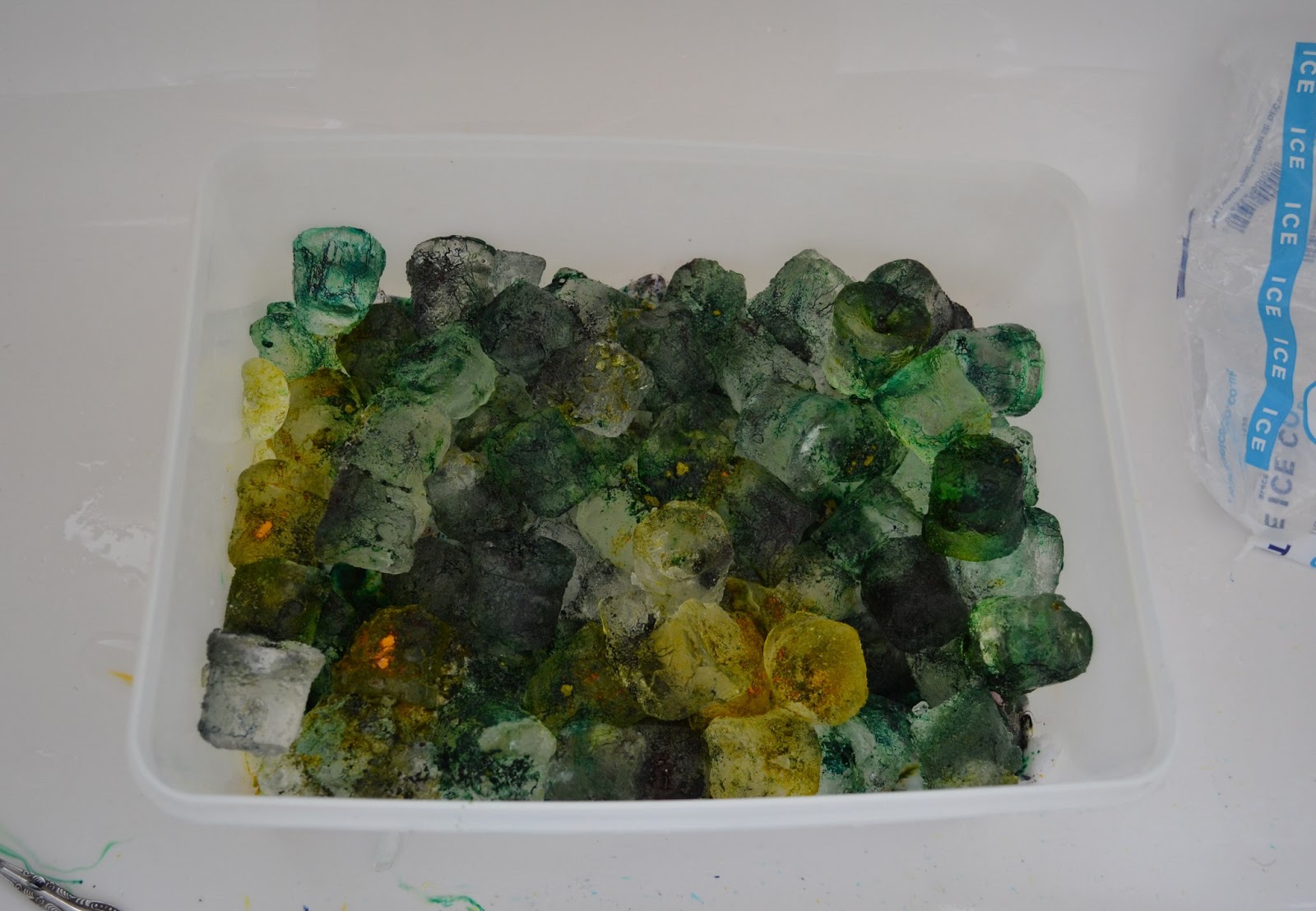
This is one of my favourite ways of dyeing fabric at the moment and it is so easy to set up. Just soak the fabric in a soda/salt solution (I use 100g of soda ash + 50g of salt to 4 pints of water). soak for at least an hour. Squeeze out any excess soda soak and arrange the fabric in the bottom of a deep sided plastic container
You can pleat, scrunch, fold it in any way you please. Then pile some ice cubes on top
Now sprinkle some procion dye powder on top. Use two or three colours.
Then just wait for the ice to melt over night and then rinse the fabric until the water runs clear. You can then wash the pieces in the washing machine if you wish just to make sure all the loose dye is out


Friday, 12 April 2013

Inspired by The Staffordshire Hoard

Finally finished my piece of embroidery for the West Midlands Embroiderers' Guilds exhibition - "INSPIRED BY THE STAFFORDSHIRE HOARD".  I am still not sure how much I like the piece, but at least it is now on the way to the first exhibition venue!

The exhibition is being held at The Potteries Museum, Bethesda Street , Stoke on Trent ST1 3DW from April 20th - June 16th and will feature work from a number of E.G. groups from across the West Midlands. Solihull Guild have sent 10 pieces.


 This is a photo of my piece based on a very mangled find from the Staffordshire Hoard collection, thought originally to be part of a shield decoration.

Two of a Kind